Deep dives
Go beyond the artwork.
These are the first on-site educational articles. We can expand each one further before launch.

Week 11 · Gold
How Rare Is Gold?
Gold exists throughout the Earth’s crust, but usually at extremely low concentrations. Mining becomes practical only where geological processes have concentrated it enough for extraction to make economic and technical sense.
What to understand
- Gold cannot be manufactured by ordinary industrial processes; new supply must be mined or recycled.
- Exploration, permitting, construction and extraction can take years, so mine supply does not instantly respond to price.
- Gold is highly durable, meaning much of the metal mined historically still exists in jewellery, investment products, reserves or other forms.
Key takeaway: Rarity is one part of gold’s story. Durability, demand, liquidity and global recognition matter too.
↑ Back to Learning Hub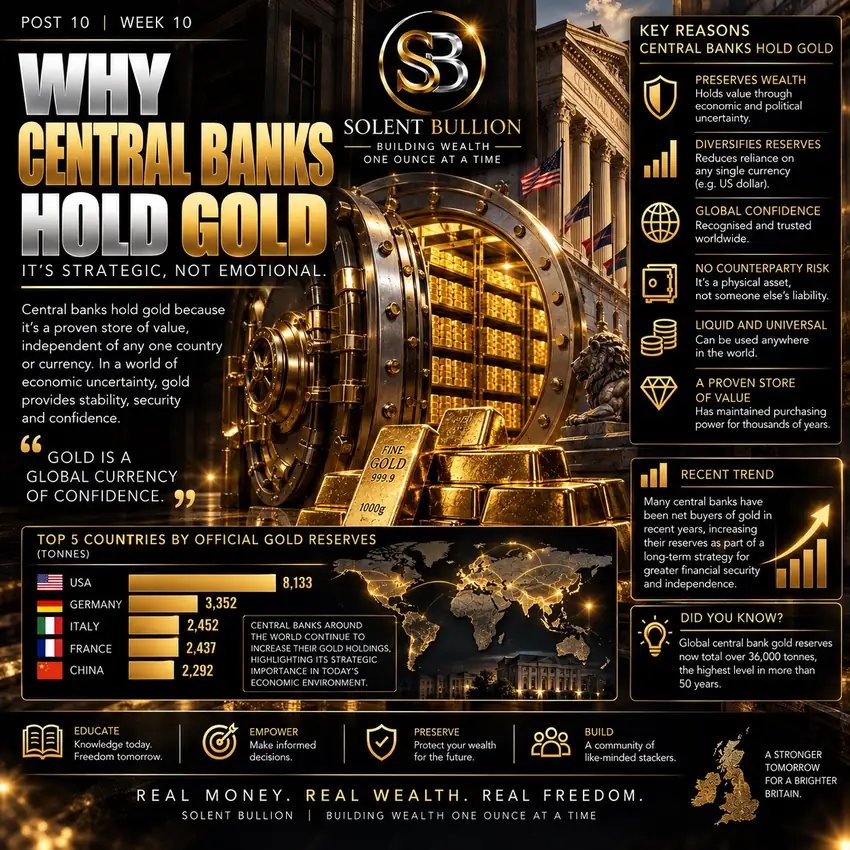
Week 10 · Reserves
Why Central Banks Hold Gold
Central banks can hold gold as part of their official reserves alongside currencies and other reserve assets. The reasons are strategic rather than emotional.
What to understand
- Diversification: gold behaves differently from many financial assets and currencies.
- No issuer: physical gold is not another government’s or company’s promise to pay.
- Liquidity: gold trades in a large global market.
- Confidence: it has a long history of international recognition.
Key takeaway: Central-bank ownership helps illustrate gold’s reserve characteristics, but it does not mean the price must always rise.
↑ Back to Learning Hub
Week 9 · Strategy
Gold Isn’t a Get-Rich-Quick Investment
Physical gold can rise and fall sharply. Treating it as a guaranteed short-term profit machine misses the reason many long-term holders are interested in it.
What to understand
- Consider the role you expect gold to play before buying it.
- Understand that physical bullion includes dealing spreads and premiums.
- Avoid confusing a long-term wealth-preservation idea with a short-term price prediction.
- Keep precious metals in context with cash, pensions, shares and other assets rather than viewing one asset as a complete financial plan.
Key takeaway: No hype, no overnight-rich promises — understand the asset and think in years, not days.
↑ Back to Learning Hub
Week 8 · Bullion coins
The British Britannia
The Britannia is one of the UK’s best-known bullion coin families. Modern gold and silver Britannias combine recognisable designs with defined precious-metal content and security features.
What to understand
- Check the metal, weight and fineness of the exact coin.
- Compare dealer reputation and total price, not just the headline premium.
- Consider condition and packaging if those matter to you.
- Check current UK tax rules for your own circumstances because tax treatment can change.
Key takeaway: A familiar coin can be easy to understand, but familiarity does not remove the need to compare price, authenticity and suitability.
↑ Back to Learning Hub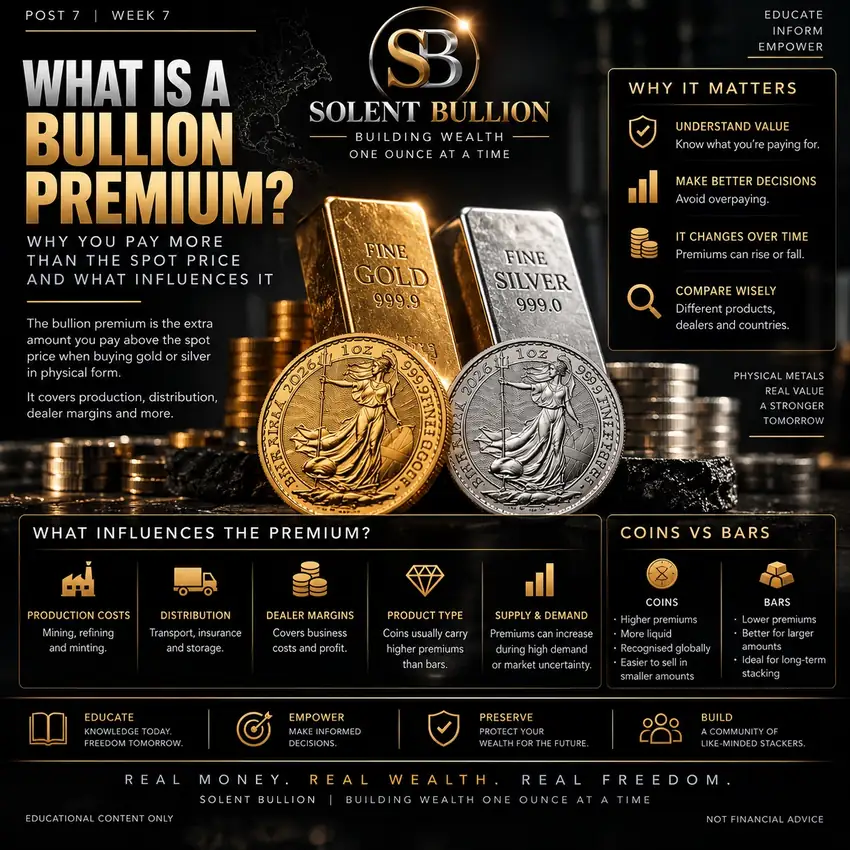
Week 7 · Pricing
What Is a Bullion Premium?
The spot price is not normally the final price you pay for a physical coin or bar. A premium is the amount above the metal’s reference value charged for the finished product and the route that brings it to you.
What to understand
- Manufacturing and minting costs.
- Product size — smaller pieces can cost more per ounce to produce and distribute.
- Dealer costs, availability and market demand.
- Brand, format, packaging and the ease with which a product can be resold.
Key takeaway: Compare the total price and the product you receive, not premium percentage in isolation.
↑ Back to Learning Hub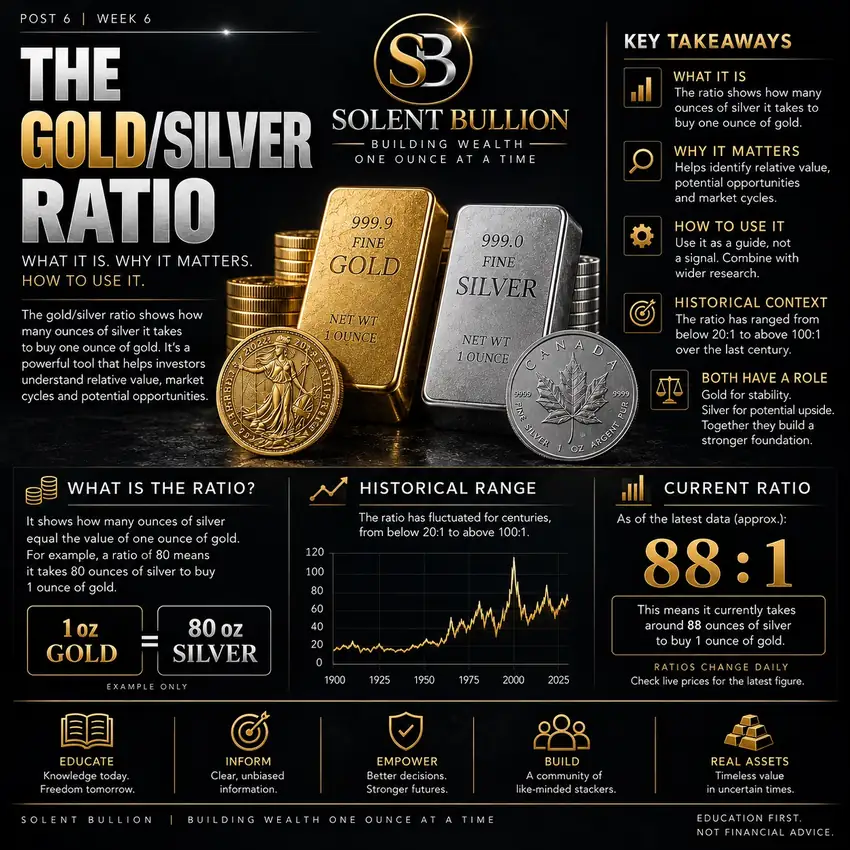
Week 6 · Market education
The Gold/Silver Ratio
The gold/silver ratio tells you how many ounces of silver are equivalent to the price of one ounce of gold at a given moment. It changes as the two metals move relative to each other.
What to understand
- It provides a simple way to compare relative prices over time.
- A rising ratio means gold is becoming more expensive relative to silver; a falling ratio means silver is gaining relative to gold.
- It is descriptive, not a guaranteed buy or sell signal.
Key takeaway: The ratio gives context. It does not tell you where either metal must go next.
↑ Back to Learning Hub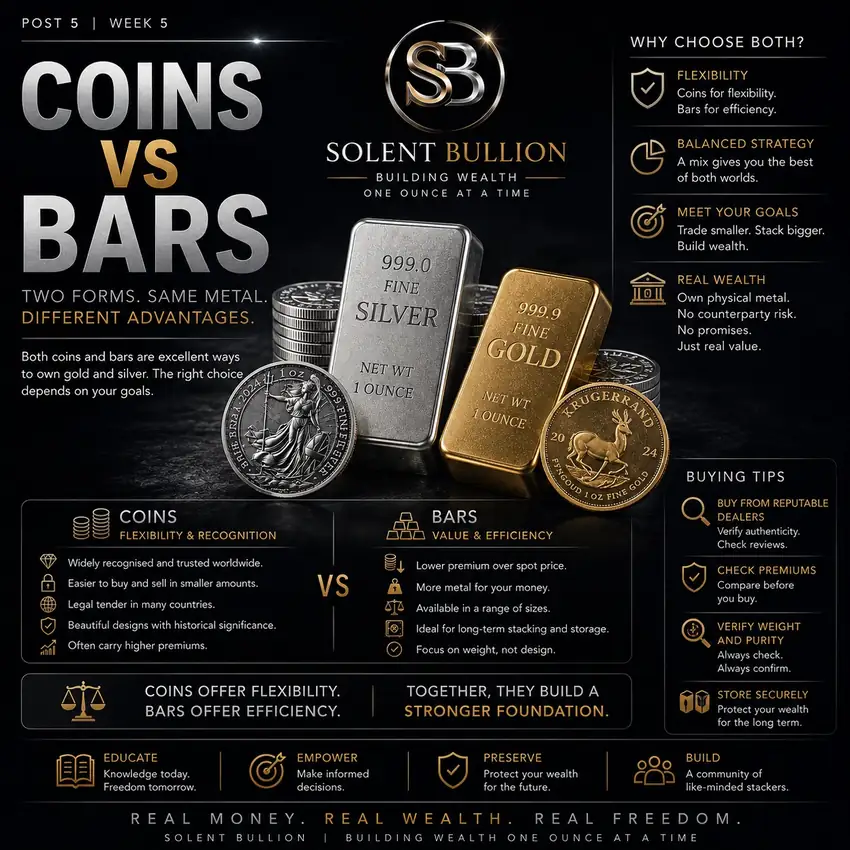
Week 5 · Products
Coins vs Bars
Both can provide exposure to physical precious metal, but they are packaged differently and can suit different priorities.
What to understand
- Coins are often highly recognisable and can offer flexible unit sizes.
- Bars can be efficient for larger weights and reduce packaging per ounce.
- Premiums vary by product, size, manufacturer and market conditions.
- Compare authenticity, liquidity, total cost, storage and your own objective.
Key takeaway: There is no universal winner. The right format depends on what you value most.
↑ Back to Learning Hub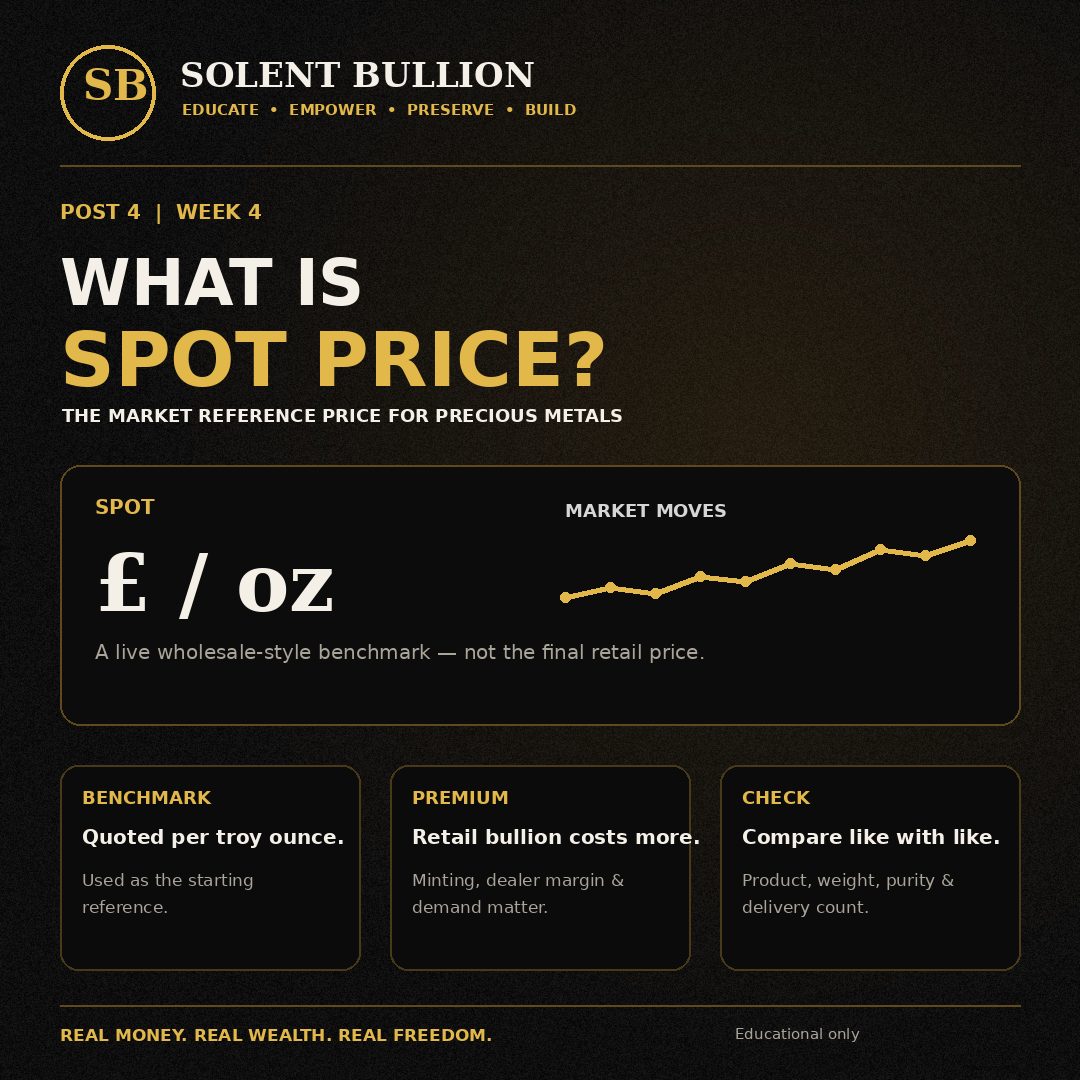
Week 4 · Foundations
What Is Spot Price?
Spot price is a widely used reference price for precious metal in the wholesale market. It gives the market a common benchmark, but it is not the same as the retail price of a physical coin or bar.
What to understand
- Retail bullion normally includes a premium above the underlying metal value.
- Buy and sell prices can differ.
- Currency matters: a UK buyer sees the effect of both the metal’s international price and the GBP exchange rate.
- Taxes, delivery and other costs may apply depending on the product and transaction.
Key takeaway: Spot is the starting reference — not necessarily the final checkout price.
↑ Back to Learning Hub
Week 3 · Silver
Why Silver Is Different
Silver has a long monetary history, but today it is also an important industrial material. That combination gives it a different demand profile from gold.
What to understand
- Industrial applications can influence demand alongside investment interest.
- Its lower price per ounce makes physical silver accessible in smaller cash amounts, but a large value of silver takes more physical space than the same value of gold.
- Silver can be more volatile than gold, moving sharply in both directions.
Key takeaway: Silver is not simply ‘cheap gold’. Its economics, uses and price behaviour are different.
↑ Back to Learning Hub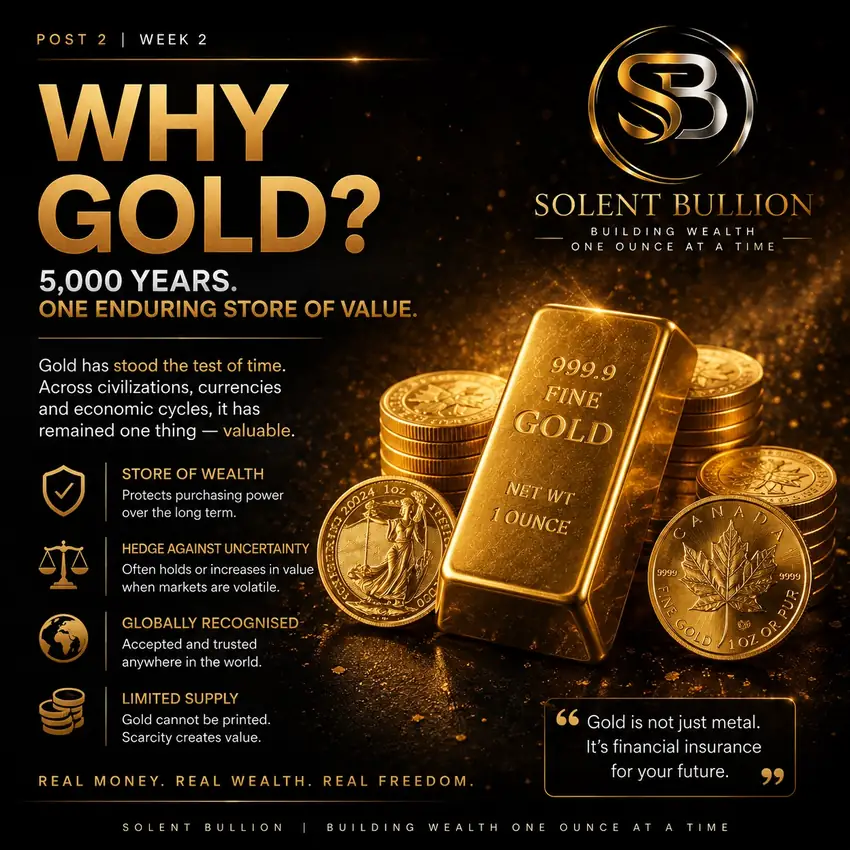
Week 2 · Gold
Why Gold?
Gold has remained desirable across different societies because of an unusual combination of physical and economic characteristics.
What to understand
- Scarcity: economically recoverable gold is limited.
- Durability: it resists corrosion and can survive for very long periods.
- Divisibility: it can be refined and formed into standardised units.
- Recognition: gold has a deep, global market and a long history of use as a store of value.
Key takeaway: Gold can play a role in a wider strategy, but it still has price risk and should be understood before it is bought.
↑ Back to Learning Hub